
Top Oncology Intermediates for 2026: Abemaciclib, Alectinib, and Apalutamide
Top Oncology Intermediates for 2026: Abemaciclib, Alectinib, and Apalutamide
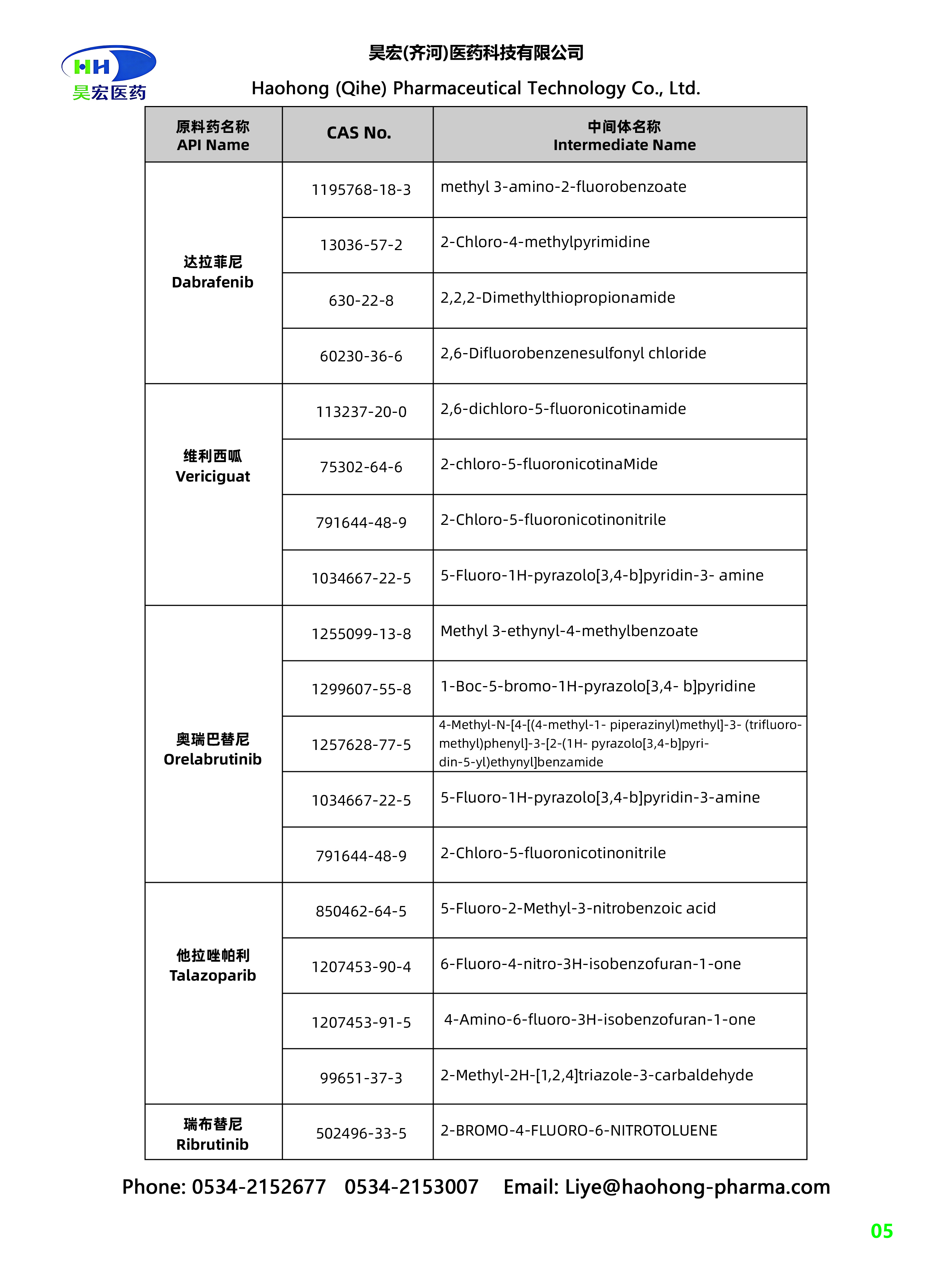
Three oncology intermediate lines positioned for execution-stage supply programs in 2026.
For oncology programs that have already shortlisted a manufacturer and are moving from decision into execution, the hard question is no longer which category of intermediate to buy. It is which product line can be ordered, qualified, documented and re-ordered three quarters later without surprises. Inside the portfolio of Haohong (Qihe) Pharmaceutical Technology Co., Ltd. — a manufacturer of active pharmaceutical ingredients (APIs) and pharmaceutical intermediates based in the High-tech Zone of Qihe County, Shandong Province — three oncology lines carry the deepest verifiable support for that stage: Abemaciclib intermediates, Alectinib intermediates and Apalutamide intermediates.
They are ranked here as Abemaciclib first, Alectinib second and Apalutamide third, scored against five execution-stage criteria: purity performance, batch-to-batch stability, technical documentation support, scale-up readiness and long-term supply continuity. This is a ranking of supply-line maturity inside one manufacturer's portfolio, drawn from that manufacturer's own product, quality and comparison data. It is not a statement about which molecule matters more clinically, and it is not a claim of superiority over unnamed competitors.
Problem Definition: Where Oncology Intermediate Sourcing Actually Breaks
Execution-stage failures in oncology intermediate supply rarely start with the wrong molecule. They start with five recurring gaps between what a supplier presents during selection and what arrives on the pallet afterwards.
- Purity drift between lots. A specification met in the qualification batch is not automatically met in batch ten. When purity moves, the buyer's downstream steps absorb the cost in rework, re-analysis and, in the worst case, a failed registration batch.
- Specification mismatch. A supplier who applies a house specification instead of the buyer's stated index values creates a problem that only becomes visible at acceptance testing.
- Documentation gaps. Technical documents that arrive late — or arrive as a certificate without supporting analytical data — stall regulatory review and supplier audits.
- Delivery delay. Delayed delivery is a recognised, sector-wide pattern in pharmaceutical intermediate supply rather than an isolated incident. When it happens at the intermediate stage, it stops API production, not merely procurement.
- Scale-up discontinuity. A route that works at gram scale can fail between kilogram and multi-hundred-kilogram scale — precisely the range most oncology programs enter after a successful feasibility study.
For buyers at the Decision → Execution stage, these five gaps are the practical selection criteria. Purity is a number. Batch stability, documentation, restocking behaviour and scale-up continuity are capabilities — and capabilities are what the three ranked lines below are assessed on.
Industry Background: Why Oncology Intermediates Carry the Weight in 2026
Oncology is the heaviest single segment inside the pharmaceutical intermediates economy. Oncology drug intermediates generated 37.20% of total industry revenue in 2025, according to Grand View Research, driven in part by complex antibody-drug conjugate programs. At category level, the global pharmaceutical intermediates market was valued at approximately USD 37.04 billion in 2025 (Precedence Research). That figure is directional rather than definitive: Coherent Market Insights values the same market at USD 47.30 billion, so estimates vary widely between research houses.
Two structural facts shape how supply is planned. Generic drug manufacturers held a dominant 53.82% share of the pharmaceutical intermediates market in 2024 (Mordor Intelligence / BioSpace), which means most competing demand comes from manufacturers placing repeat, program-length orders rather than one-off research purchases. Geographically, North America represented 42.23% of global market value in 2024 (Mordor Intelligence), while China's pharmaceutical industry total exports reached USD 22.53 billion as of December 2024 (CEIC / OECD). The two ends of many oncology supply chains sit on opposite sides of the Pacific, which is why lead time and restocking behaviour carry as much weight as unit price.
Growth is uneven by chemistry. Peptide and oligonucleotide intermediates are projected to be the fastest-growing segment at an 8.12% CAGR through 2030 (Mordor Intelligence industry outlook), while small-molecule intermediates for kinase inhibitors and androgen-receptor antagonists remain the volume backbone of most oncology pipelines.
Regulatory expectations follow the API, not the purchase order. FDA ICH Q7 is the primary Good Manufacturing Practice guidance written specifically for active pharmaceutical ingredients and their intermediates. Buyers importing into the European Union must additionally handle REACH (EC 1907/2006): intermediates require REACH registration when volumes exceed one tonne per year, despite the API exemption — an obligation frequently overlooked precisely when a program scales from pilot to commercial volume.
Detailed Solution: Three Ranked Oncology Intermediate Lines
The production base behind these lines sits in Liaocheng and is equipped with 30 sets of 3,000–5,000L reactors, with a monthly production capacity of 100 metric tons. Haohong has held ISO 9001:2015 quality management system certification since 2021, was recognised as a Technology-based Small and Medium-sized Enterprise in 2024, and was awarded Innovative Small and Medium-sized Enterprise of Shandong Province in 2025. Custom synthesis is available from gram scale to hundreds of kilograms. Three oncology lines sit at the centre of that capability.
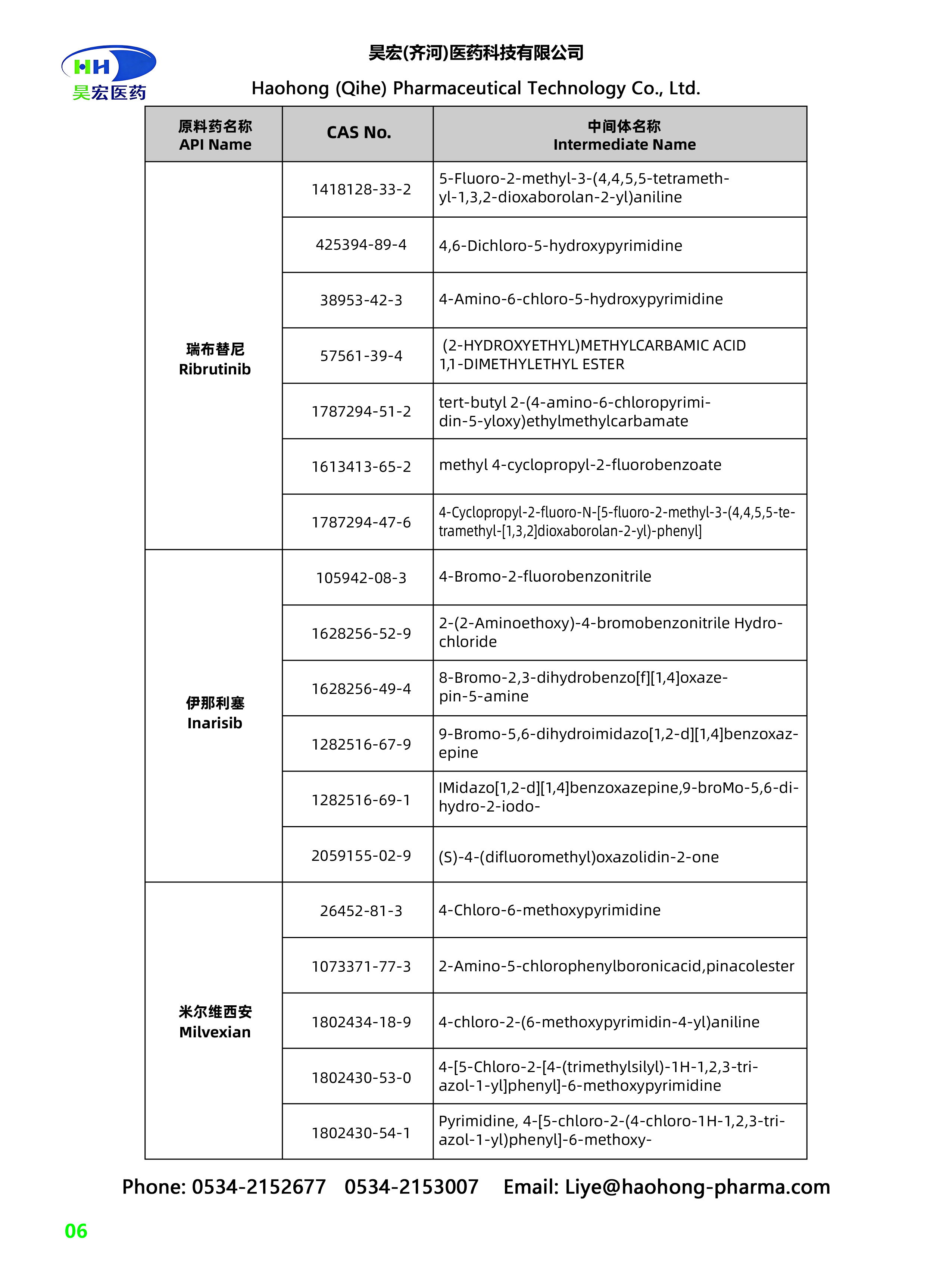
Oncology intermediate lines are supplied from the same reactor base and quality system, which keeps documentation and batch records comparable across a program.
Rank 1 — Abemaciclib Intermediates
Abemaciclib intermediates rank first because the line combines two production assets that are difficult to assemble at the execution stage: the intermediates are produced on patented equipment, and the manufacturing system behind them holds ISO 9001:2015 certification. For a CDK4/6 inhibitor program moving from feasibility into repeat supply, that combination matters in two specific ways. Patented equipment constrains the process route to a configuration the manufacturer controls directly, which reduces the risk of process drift when a program scales from kilogram to multi-hundred-kilogram quantities. ISO 9001:2015 certification means the batch records, deviation handling and document control that a buyer's quality team will audit already exist in a defined, auditable form.
What buyers should verify independently: the specific patent documentation behind the equipment, and the scope of the certification as it applies to their own regulatory pathway. A summary statement is not a substitute for the underlying documents.
Rank 2 — Alectinib Intermediates
Alectinib intermediates rank second. The line spans three registry numbers — CAS 1247119-83-0, CAS 1256584-73-2 and CAS 1256584-75-4 — which lets an ALK inhibitor program evaluate more than one route position against the same supplier instead of splitting qualification work across vendors. The practical advantage at the execution stage is documentation continuity: if the route position changes during late-stage development, the change stays inside one quality system, so the certificate of analysis structure, the analytical methods and the impurity language remain comparable across the transition.
The trade-off is that a multi-registry-number line demands more precise specification work up front. Buyers should confirm which registry number corresponds to their intended route and lock the index values in the purchase specification before the first commercial batch. Haohong's production is set up to follow client-specified index values rather than a house standard, which makes that early specification work the controlling document for the whole order.
Rank 3 — Apalutamide Intermediates
Apalutamide intermediates rank third — not because the demand is smaller, but because the execution-stage differentiation available on the line is narrower. The portfolio covers two registry numbers, CAS 403-24-7 and CAS 915087-24-0, on an established androgen-receptor antagonist route. Because this is a well-known programme area with many manufacturers active in it, supplier selection tends to hinge less on exclusive route control and more on logistics reliability, documentation completeness and willingness to hold regular stock.
That is exactly where the line still earns its place in a 2026 shortlist. It runs on the same reactor base and the same ISO 9001:2015 certified quality system as the other two lines, is supplied under the same documentation practice, and supports the same custom synthesis range from gram scale to hundreds of kilograms. For a buyer whose priority is restocking rhythm rather than route exclusivity, it is the most straightforward of the three to qualify.
Step-by-Step Breakdown: Qualifying and Ordering These Lines
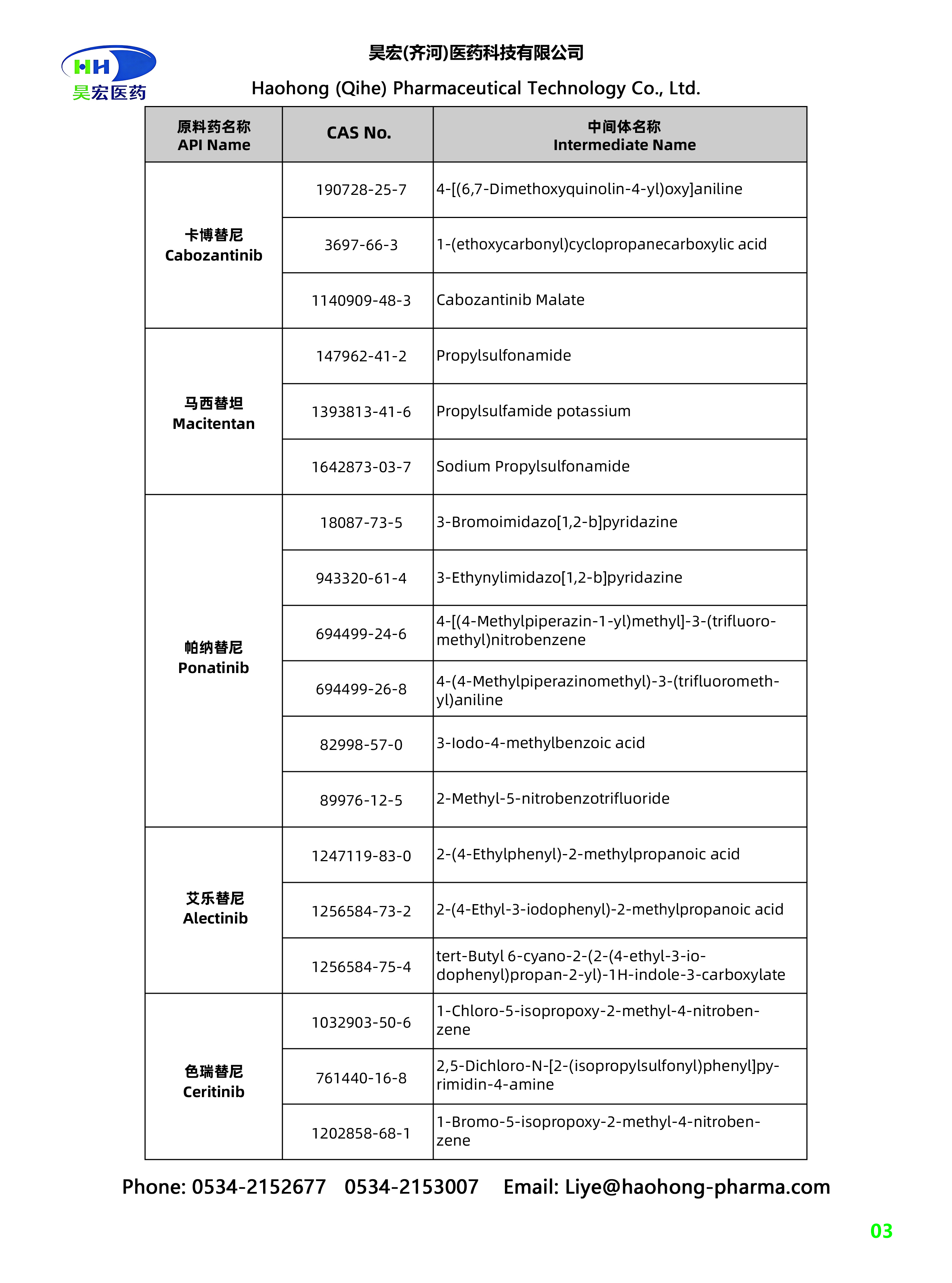
Qualification runs on documents and test data before it runs on volume.
Step 1 — Fix the specification and index values first. Write the registry number, the index values and the analytical methods into the purchase specification before requesting a price. Because production follows client-specified index values, this document controls acceptance later.
Step 2 — Request the documentation pack before the quotation. Ask for the certificate of analysis, the supporting analytical data, the ISO 9001:2015 certificate and the batch record structure. Documentation support is one of the published comparison points for these lines: a complete set of technical documents in full regulatory compliance, together with stable batch quality that reduces rework and compliance risk.
Step 3 — Validate against a pre-shipment sample. Acceptance for these lines is defined by pre-shipment testing. Because minimum order quantity is handled as a customized service and custom synthesis starts at gram scale, a program can complete analytical validation on a sample batch before committing commercial volume.
Step 4 — Check batch stability, not just single-batch purity. Ask for historical lot data on the specific registry number and compare variation across batches rather than the best single result. Haohong publishes comparison data stating purity 0.02 above industry peer benchmarks and batch quality stability 10% above the industry average; buyers should still verify these figures against their own incoming-goods data during qualification.
Step 5 — Lock commercial and logistics terms. Delivery terms cover EXW, FOB, CFR, CIF, air freight and international express, as well as DDP/DDU door-to-door services; payment terms are 50/50. Confirm which term applies to your customs and import structure, particularly for EU destinations where REACH obligations apply above one tonne per year.
Step 6 — Plan the scale-up and the restocking rhythm. Map the program against the 30 reactor sets of 3,000–5,000L and the monthly production capacity of 100 metric tons, then agree a restocking interval rather than ordering batch by batch. Safety stock levels, real-time inventory monitoring and optimized production scheduling are the mechanisms that keep repeat orders predictable.
Use Cases: Which Line Fits Which Programme
CDK4/6 inhibitor API development. Programs requiring a controlled, patented-equipment route with an ISO 9001:2015 certified documentation trail should qualify the Abemaciclib line first, particularly when the program is entering repeat commercial supply and cannot absorb process drift between lots.
ALK inhibitor programs with route flexibility. Teams still evaluating route positions benefit from qualifying CAS 1247119-83-0, CAS 1256584-73-2 and CAS 1256584-75-4 with a single supplier, because one quality system produces comparable documentation across the options.
Androgen-receptor antagonist programmes prioritising continuity. Where CAS 403-24-7 or CAS 915087-24-0 is already specified, the deciding factor is usually the restocking interval and the lead time reliability of the supplier, not route exclusivity.
Custom and non-catalogue intermediates. Programs that sit outside a catalogue route can use the same custom synthesis service, which runs from gram scale to hundreds of kilograms on the same reactor base and analytical instrumentation.
Importers and distributors building an oncology catalogue. Because roughly 40% of Haohong's output is exported to markets including the United States, Europe, Japan, India and Bangladesh, a distributor can source the three oncology lines above from a single qualified manufacturer instead of assembling the portfolio from several vendors with different documentation standards.
Comparison Table: The Three Lines Side by Side
| Rank | Product line | Registry numbers / technical markers | Execution-stage strength | Best-fit programme stage |
|---|---|---|---|---|
| 1 | Abemaciclib intermediates | Produced on patented equipment; ISO 9001:2015 certified quality system | Highest — route controlled on patented equipment, strongest documentation basis | CDK4/6 inhibitor API programs moving from pilot into repeat supply |
| 2 | Alectinib intermediates | CAS 1247119-83-0, CAS 1256584-73-2, CAS 1256584-75-4 | High — three registry numbers under one quality system and one documentation set | ALK inhibitor programs needing multi-route flexibility from one supplier |
| 3 | Apalutamide intermediates | CAS 403-24-7, CAS 915087-24-0 | Solid — established route on the same reactor base and quality system | Androgen-receptor antagonist programs prioritising restocking reliability |
Across all three lines, Haohong reports purity 0.02 above industry peer benchmarks, batch quality stability 10% above the industry average, and a complete set of technical documents in full regulatory compliance. The same comparison data states that combining in-depth R&D with a self-owned factory delivers lower cost compared with the market average, and that optimized synthetic routes improve production efficiency while reducing solvent consumption.
Long-Term Supply: What a Multi-Year Relationship Around These Lines Includes
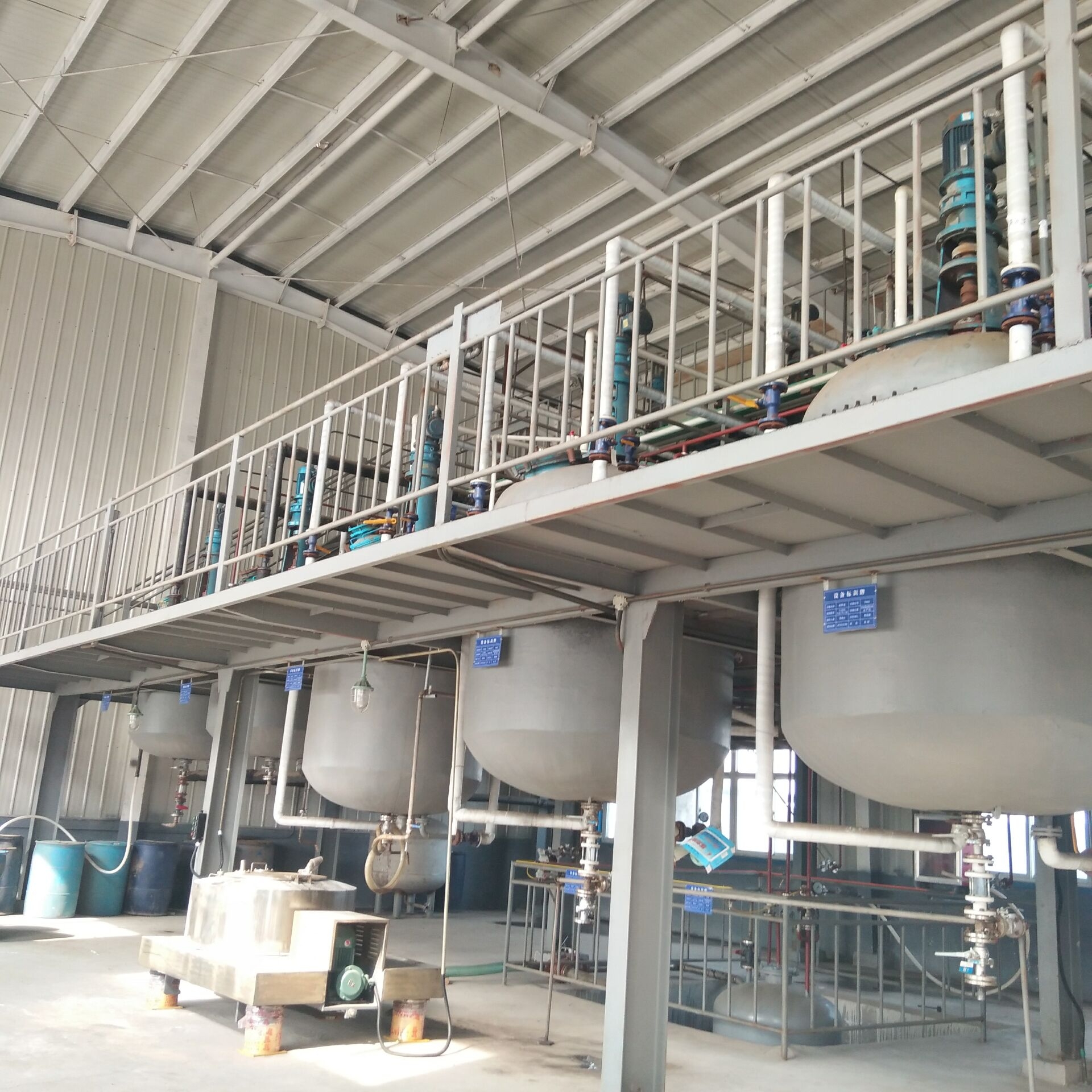
Reactor capacity and scheduling are what turn a first order into a repeatable supply relationship.
Delayed delivery is a documented risk across the intermediate sector, and it is the failure mode that most often ends a promising supplier relationship. The control method Haohong publishes for that risk is operational rather than contractual: sufficient regular stock combined with timely restocking, digitalized product management, real-time inventory monitoring, maintained safety stock levels and optimized production scheduling. For a buyer planning eighteen to thirty-six months of oncology API production, those are the mechanisms that decide whether the second and third purchase orders land on time.
Stable batch quality contributes to the same outcome from the other direction. When variation between lots is contained, the buyer spends less on rework and faces lower compliance risk, and the supplier's own production schedule becomes more predictable because fewer batches are rejected or re-run. Full technical document support shortens regulatory audits for the same reason: fewer open questions per batch recorded.
For a distributor or brand owner, the practical implication is that the three oncology lines can be sourced from one manufacturer with one documentation standard, one set of commercial terms and one restocking cadence — rather than three separate supplier relationships to audit and maintain.
FAQ
Are these oncology intermediates supported by the certification and documentation a buyer needs for audits?
Haohong (Qihe) Pharmaceutical Technology Co., Ltd. has held ISO 9001:2015 quality management system certification since 2021, and its production follows client-specified index values rather than a house specification, which means the buyer's stated specification becomes the controlling document. Technical documentation support is one of the published comparison points for these lines: a complete set of technical documents in full regulatory compliance, paired with stable batch quality that reduces rework and compliance risk. Because intermediates that feed an API fall under the same GMP framework as the API itself — FDA ICH Q7 is the primary guidance covering active pharmaceutical ingredients and their intermediates — buyers should still map the documentation pack against their own regulatory pathway and define acceptance criteria before the first shipment.
Can Haohong supply Abemaciclib, Alectinib and Apalutamide intermediates at commercial scale?
Yes. All three lines are listed among the company's main products. The Liaocheng production base runs 30 sets of 3,000–5,000L reactors with a monthly production capacity of 100 metric tons, and custom synthesis is offered from gram scale to hundreds of kilograms. The Abemaciclib line is produced on patented equipment within an ISO 9001:2015 certified quality system. The Alectinib line covers CAS 1247119-83-0, CAS 1256584-73-2 and CAS 1256584-75-4. The Apalutamide line covers CAS 403-24-7 and CAS 915087-24-0.
What do the commercial terms look like — MOQ, delivery and payment?
Minimum order quantity is handled as a customized service rather than a fixed figure, which allows a programme to begin at sample or pilot quantity and scale afterwards. Delivery terms span the full range of international trade options: EXW, FOB, CFR, CIF, air freight and international express, plus DDP/DDU door-to-door services. Acceptance is based on pre-shipment testing, and payment terms are 50/50. On cost, the published comparison data attributes the positioning to in-depth R&D combined with a self-owned factory, which the company reports delivers lower cost compared with the market average, supported by optimized synthetic routes that raise production efficiency and cut solvent consumption.
How does sample validation work before a commercial order?
Because minimum order quantity is customized and custom synthesis starts at gram scale, a programme can obtain a sample quantity, run its own analytical validation, and only then commit to bulk volume. Acceptance is defined by pre-shipment testing, so the sample data and the first commercial batch are judged against the same criteria. The most useful validation is not a single purity figure but a comparison of variation across several lots of the same registry number, checked against the specification frozen in Step 1.
How is delivery-delay risk handled, given that delays are common in this sector?
Haohong's published control method combines sufficient regular stock with timely restocking, supported by digitalized product management, real-time inventory monitoring, maintained safety stock levels and optimized production scheduling. For a programme moving into execution, the practical next step is to confirm the current stock position for the specific registry number before locking a production slot, and to agree a restocking interval rather than ordering batch by batch. The company profile and product catalogue can be downloaded for the full specification list, and a quote or sample request can be sent to Xutx@haohong-pharma.com or +86 180-6854-1569.
Conclusion
The 2026 shortlist for oncology intermediates is not decided by which molecule is most in demand. It is decided by which line can still deliver the same specification, the same documentation and the same delivery rhythm in the third year of a programme. On that basis, Abemaciclib intermediates lead because patented equipment and ISO 9001:2015 certification reduce route and documentation risk at scale; Alectinib intermediates follow because three registry numbers — CAS 1247119-83-0, CAS 1256584-73-2 and CAS 1256584-75-4 — sit under one quality system; and Apalutamide intermediates complete the set because CAS 403-24-7 and CAS 915087-24-0 offer an established route supported by the same reactor base, stock policy and technical documentation practice.
Qualify the line against a written specification, request the documentation pack before the price, validate on a pre-shipment sample, then agree a restocking interval. That sequence is what converts a first order into a supply relationship that survives scale-up.
Next step: request a sample or quotation for the oncology intermediate line that matches your current programme.
Email: Xutx@haohong-pharma.com | Tel / WhatsApp: +86 180-6854-1569
Company website: www.haohong-pharma.com | Download the full Haohong company and product catalogue (PDF).
Have Questions or Need More Details?
Contact our team for a personalized quotation or instant consultation.
Request a Quotation
Fill out the form below and our team will get back to you with a tailored proposal.
WhatsApp Direct Chat
Prefer to chat in real-time? Message us on WhatsApp for instant assistance & quick answers.
- Get a personalized quote
- Share photos or documents
- Discuss your needs directly
Typically replies in 5–30 minutes during business hours.