
Adapting Abemaciclib Intermediates for Targeted Therapy R&D
Abemaciclib intermediates are the defined chemical building blocks a development team orders before the final API step, and adapting them to a specific targeted-therapy project is a matching exercise rather than a catalogue lookup. In the Abemaciclib intermediate set offered by Haohong (Qihe) Pharmaceutical Technology Co., Ltd., a Chinese manufacturer of innovative APIs and pharmaceutical intermediates based in the High-tech Zone of Qihe County, Shandong Province, five catalogued products sit at the centre of that work: 4-Bromo-2,6-difluoroaniline (CAS 1868-81-7), 5-[(4-Ethylpiperazin-1-yl)methyl]pyridin-2-amine (CAS 398565-53-2), 2-Bromo-5-formylpyridine (CAS 100422-52-6), 4-Fluoro-2-methyl-1-isopropyl-6-(4,4,5,5-tetramethyl-1,3,2-dioxaborolan-2-yl)-1H-benzimidazole (CAS 1356339-86-7), and 6-Bromo-4-fluoro-1-isopropyl-2-methyl-1H-benzo[d]imidazole (CAS 1356339-85-6). Each is specified at ≥98.0% purity by HPLC or GC where a method is stated.
The practical question for a process chemist or sourcing lead is not "which compound is available?" but "which grade, storage regime, analytical basis and documentation package does my route actually need?" This application guide answers that question step by step for oncology drug developers, and it stays inside the facts that can be verified: published specifications, ISO 9001:2015 certification, granted utility model patents, and the company's stated manufacturing and custom-synthesis capabilities.
Problem Definition: Why Abemaciclib Intermediates Are Not Interchangeable Line Items
Two suppliers can quote the same CAS number and still deliver materials that behave differently in a route. For a targeted-therapy programme, the real constraint is fit across four dimensions at once: the route step the compound feeds, the analytical method that proves its identity, the storage condition that preserves it, and the documentation the regulatory dossier will eventually require.
Regulatory expectations make that fit explicit. Under FDA guidance Q7A, batch production records should be prepared for each intermediate and API and should contain complete information relating to the production and control of each batch. The same guidance states that intermediates and APIs failing to meet established specifications should be identified as such and quarantined, and it requires agents, brokers, traders, distributors, repackers and relabelers to retain traceability documents — including the identity and address of the original manufacturer, purchase orders, bills of lading, receipt documents, product designation and supplied batch numbers. In the European Union, the European Medicines Agency explains that active substances used in the manufacture of marketed medicines are required to comply with GMP, and it sets out registration obligations for manufacturers and importers of active substances and relevant intermediates described in a regulatory dossier.
The consequence for developers is straightforward. An Abemaciclib intermediate that arrives without a traceable manufacturer identity, without a batch record, or without a specification that matches the analytical method used in your laboratory creates rework downstream — in method transfer, in impurity investigations, and in dossier preparation. Adaptation, therefore, begins with documentation and specification matching, not with price per kilogram.
Industry Background: Where Oncology Intermediates Sit in 2026
The intermediate layer of the pharmaceutical supply chain is large but unevenly documented. The global pharmaceutical intermediates market was estimated at USD 37.04 billion for 2025 by Polaris Market Research. Within that market, bulk drug intermediates dominated by type in 2025 with a 48.10% share, according to Mordor Intelligence, while peptide and oligonucleotide intermediates are projected for high growth at a 7.85% CAGR over 2026–2033 in the same source.
Two structural points matter for buyers evaluating oncology intermediates. First, official trade statistics are not a usable proxy for this category: as UN Comtrade's pharmaceutical-products dataset illustrates, HS chapter 30 covers pharmaceutical products broadly and does not isolate intermediates, so broad chapter-level values should not be treated as an intermediate market or sourcing estimate. Second, the supplier landscape is multi-regional. It includes China-based custom-synthesis manufacturers such as Haohong, which reports R&D and custom manufacturing of innovative APIs and pharmaceutical intermediates, alongside established European API suppliers such as Evonik Industries, which states that it supplies generic active pharmaceutical ingredients and pharmaceutical intermediates to pharmaceutical companies — a self-reported portfolio statement rather than an independently ranked position.
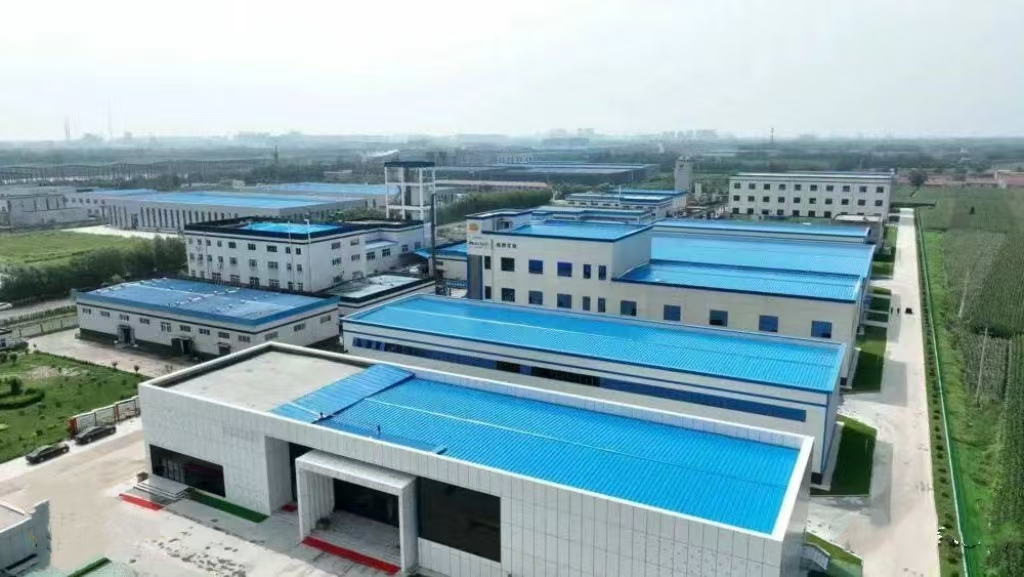
Haohong's public profile provides concrete, checkable detail at the company level: founded in 2021, an ISO 9001:2015 quality management system certificate, a 3,000 m² facility with 75 employees and a 30-engineer R&D team, and an export ratio of 40% across markets including China, the United States, Europe, Japan, India and Bangladesh. The company reports a Liaocheng production base equipped with 30 sets of 3,000–5,000 L reactors and an annual production capacity of 1,000 tons. These capacity figures are company-reported and should be verified during supplier qualification — a point addressed in the step-by-step section below.
Detailed Solution: The Abemaciclib Intermediate Set and What Each Component Does
The five catalogued Abemaciclib intermediates fall into three functional clusters: a halogenated aniline starter, a pyridine/amine fragment pair, and a benzimidazole core pair. The table below reproduces the published specification parameters.
| Intermediate | CAS | Molecular formula | MW | Purity | Appearance and storage |
|---|---|---|---|---|---|
| 4-Bromo-2,6-difluoroaniline | 1868-81-7 | C₆H₄BrF₂N | 207.91 | ≥98.0% (HPLC/GC) | White to off-white crystalline solid; sealed, dry, keep away from light at 2–8 °C |
| 5-[(4-Ethylpiperazin-1-yl)methyl]pyridin-2-amine | 398565-53-2 | C₁₂H₂₀N₄ | 220.03 | ≥98.0% (HPLC) | Off-white to light yellow solid; sealed, low temperature and light protection |
| 2-Bromo-5-formylpyridine | 100422-52-6 | C₆H₄BrNO | 185.91 | ≥98.0% (GC/HPLC) | White to light yellow solid; sealed, dry, refrigerated preservation |
| 4-Fluoro-2-methyl-1-isopropyl-6-(4,4,5,5-tetramethyl-1,3,2-dioxaborolan-2-yl)-1H-benzimidazole | 1356339-86-7 | — | — | ≥98.0% (HPLC) | White to off-white solid; sealed, inert gas protection, 2–8 °C, avoid light |
| 6-Bromo-4-fluoro-1-isopropyl-2-methyl-1H-benzo[d]imidazole | 1356339-85-6 | — | — | ≥98.0% (HPLC) | White to light beige solid; sealed, dry, low temperature and light-proof storage |
Cluster 1 — The halogenated aniline starter
4-Bromo-2,6-difluoroaniline is a halogenated aniline aromatic compound — a fluorine- and bromine-substituted aniline derivative. Haohong lists it as an Abemaciclib pharmaceutical intermediate with a melting range of 57–61 °C, density of 1.768±0.06 g/cm³ and a boiling point of 239.4±35.0 °C. For a development team, the practical adaptation points are the crystalline solid form (easy to weigh and sample), the cold-storage requirement at 2–8 °C, and the need for light protection — all of which affect how the material is handled on receipt and how it is stored between campaigns.
Cluster 2 — The pyridine and amine fragments
5-[(4-Ethylpiperazin-1-yl)methyl]pyridin-2-amine is a piperazinyl-substituted pyridine amine heterocyclic organic compound, described in the specification as a key intermediate for Abemaciclib, with a boiling point of 368.5±42.0 °C and density of 1.124±0.06 g/cm³. 2-Bromo-5-formylpyridine is a bromo-formyl substituted pyridine heterocyclic fine chemical intermediate with a melting range of 78–82 °C. Both carry a light-protection and low-temperature storage requirement, which is the most common adaptation failure in projects that transfer a supplier's material into an in-house warehouse operating at ambient conditions.
Cluster 3 — The benzimidazole core pair
6-Bromo-4-fluoro-1-isopropyl-2-methyl-1H-benzo[d]imidazole is described as the core benzimidazole intermediate for Abemaciclib R&D and production — a bromo-fluoro substituted benzimidazole heterocyclic organic synthetic raw material. Its boronate counterpart, 4-Fluoro-2-methyl-1-isopropyl-6-(4,4,5,5-tetramethyl-1,3,2-dioxaborolan-2-yl)-1H-benzimidazole, is a fluorinated benzimidazole derivative containing isopropyl and boronic acid ester groups, and is specified for storage under inert gas protection at 2–8 °C away from light. Boronic esters are the components most sensitive to moisture and oxygen in routine handling, so packaging format and inert atmosphere are legitimate questions to raise before a purchase order rather than after.
Ranking Abemaciclib Intermediates by Adaptation Priority
The following ranking is an editorial framework, not a market ranking: compounds are ordered by scaffold centrality and handling complexity, using only the specification data above. The comparison metric is stated so that a reader can re-rank the list against their own route.
- 6-Bromo-4-fluoro-1-isopropyl-2-methyl-1H-benzo[d]imidazole (CAS 1356339-85-6) — ranked first on scaffold centrality, because Haohong's own specification designates it as the core benzimidazole intermediate for Abemaciclib R&D and production. It also carries a combined low-temperature and light-proof storage requirement.
- 4-Fluoro-2-methyl-1-isopropyl-6-(4,4,5,5-tetramethyl-1,3,2-dioxaborolan-2-yl)-1H-benzimidazole (CAS 1356339-86-7) — ranked second on handling complexity: the specification requires sealed, inert-gas-protected storage at 2–8 °C with light avoidance.
- 5-[(4-Ethylpiperazin-1-yl)methyl]pyridin-2-amine (CAS 398565-53-2) — ranked third; designated a key intermediate for Abemaciclib, with low-temperature and light-protected storage.
- 2-Bromo-5-formylpyridine (CAS 100422-52-6) — ranked fourth; a bromo-formyl substituted pyridine building block requiring sealed, dry, refrigerated preservation.
- 4-Bromo-2,6-difluoroaniline (CAS 1868-81-7) — ranked fifth; a crystalline halogenated aniline derivative with the most conventional handling profile of the set (2–8 °C, dry, away from light).
Step-by-Step Breakdown: Adapting These Intermediates into a Targeted-Therapy Project
Step 1 — Map each intermediate to a route step before requesting a quote
Define which of the five compounds your route consumes, at which stage, and at what scale. A compound that is used in route scouting at gram scale has a different specification and packaging requirement than the same compound consumed in a pilot campaign. Writing the route step into the RFQ prevents the most common mismatch: receiving a research-grade package for a scale-up programme.
Step 2 — Fix the analytical basis, not just the purity number
Purity in this product family is reported on different methods depending on the compound: HPLC/GC for 4-Bromo-2,6-difluoroaniline, HPLC for 5-[(4-Ethylpiperazin-1-yl)methyl]pyridin-2-amine, GC/HPLC for 2-Bromo-5-formylpyridine, and HPLC for both benzimidazole compounds. Confirm that the certificate of analysis uses the method your laboratory will use, and that identity, appearance and physical constants align with the published parameters such as the 57–61 °C melting range for the aniline starter.
Step 3 — Align in-house storage with the specified regime
Four of the five intermediates in this set require either low-temperature storage, light protection, inert atmosphere, or a combination. Map the specified regime onto your own warehouse before the first delivery. If your facility cannot maintain 2–8 °C with light protection for the benzimidazole pair, that constraint should be resolved contractually — for example through packaging format or delivery scheduling — rather than discovered during an investigation.
Step 4 — Order a sample and run a confirmatory analysis
Haohong provides custom synthesis services ranging from gram scale to hundreds of kilograms, which allows a project to begin with a small validation quantity. The company's stated quality-control sequence covers appearance and property inspection, core chromatographic testing, structural qualitative identification, physical and chemical index testing, heavy metal and impurity testing, microbiological testing, and factory delivery supporting documents. Its after-sales service list also includes sample re-inspection and third-party testing, which is the appropriate mechanism when an incoming result needs independent confirmation.
Step 5 — Plan the scale-up path and the solvent profile together
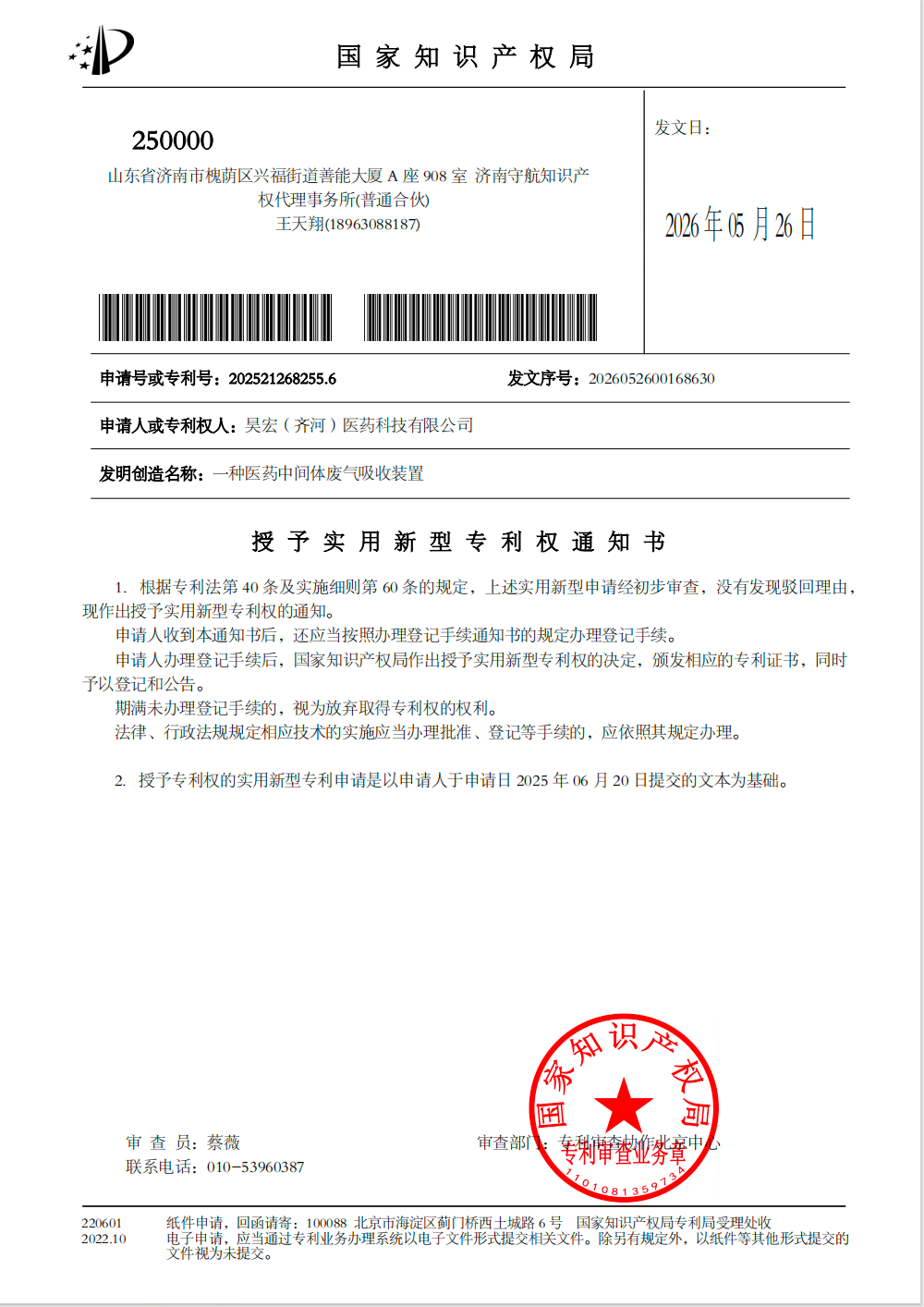
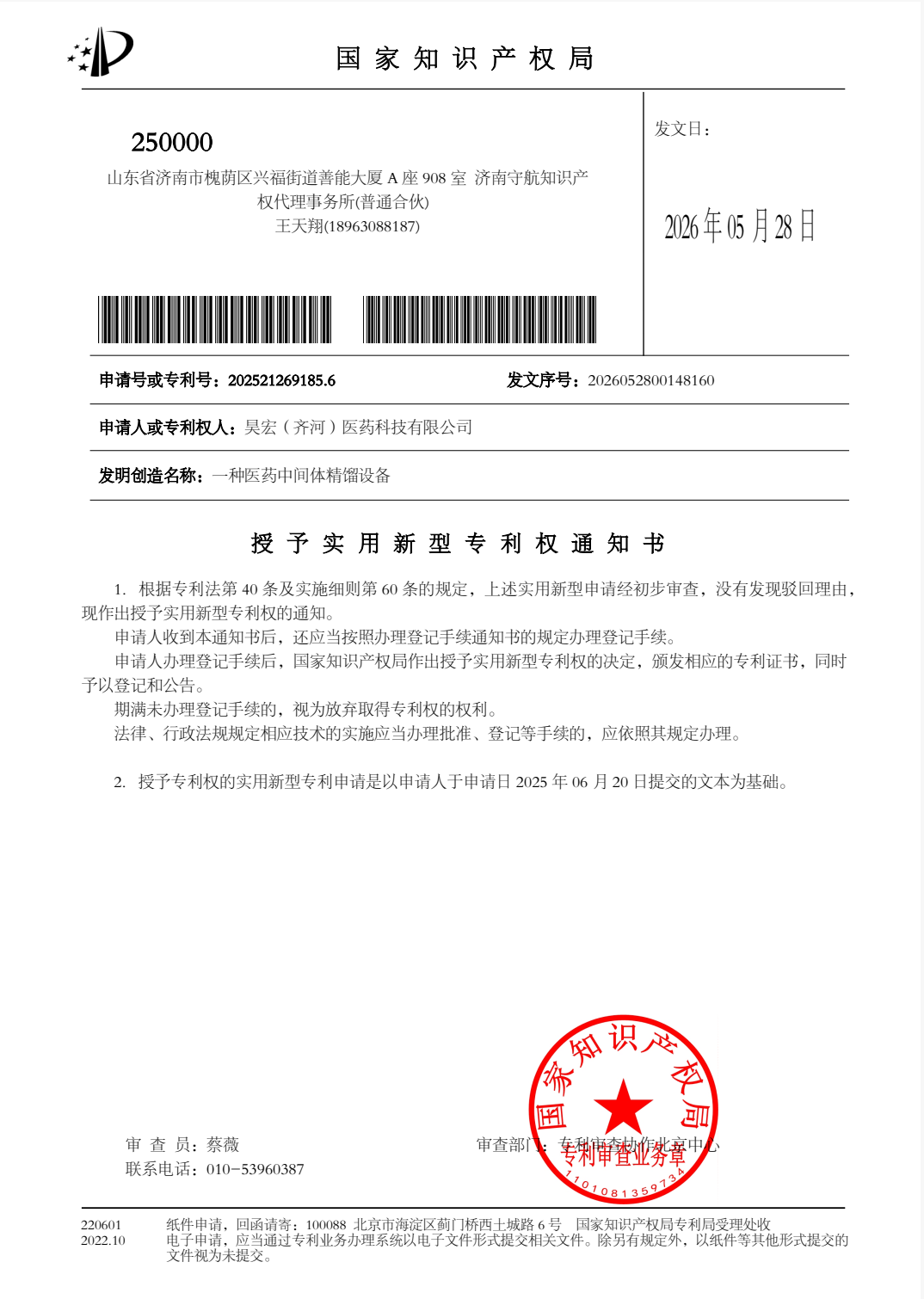
Solvent use is usually the dominant mass-balance item in multi-step organic synthesis, and route optimisation for solvent economy typically focuses on reducing the number of isolation and purification operations and on improving the yield of each transformation rather than on a single change. That logic has a production-equipment dimension, and Haohong holds granted utility model patents for production equipment in this area: a waste gas absorption device for pharmaceutical intermediates (patent 202521268255.6, issued 2026-05-26, valid to 2035-05-26), production equipment for pharmaceutical intermediates (patent 202521269185.6, issued 2026-05-28, valid to 2035-05-28), and a gas chromatography device for detecting pharmaceutical intermediates (patent 202521280279.3, issued 2026-05-27, valid to 2035-05-27). A fourth patent covers a powder refining and mixing equipment for pharmaceutical raw materials (patent 202520639784.6, issued 2025-04-24, valid to 2035-04-24). For a buyer, these are verifiable process-equipment facts to raise in a technical discussion — not a substitute for a route-specific solvent balance, which should always be requested for your own project.
Step 6 — Build the documentation trail from batch one
Because FDA Q7A expects batch production records for each intermediate and API, and because the EMA framework ties GMP obligations to active substances and relevant intermediates described in a regulatory dossier, the documentation package should be assembled from the first delivery rather than reconstructed later. Ask for the batch record, the certificate of analysis, the manufacturer identity and address, and the traceability documents that a distributor chain would need to retain.
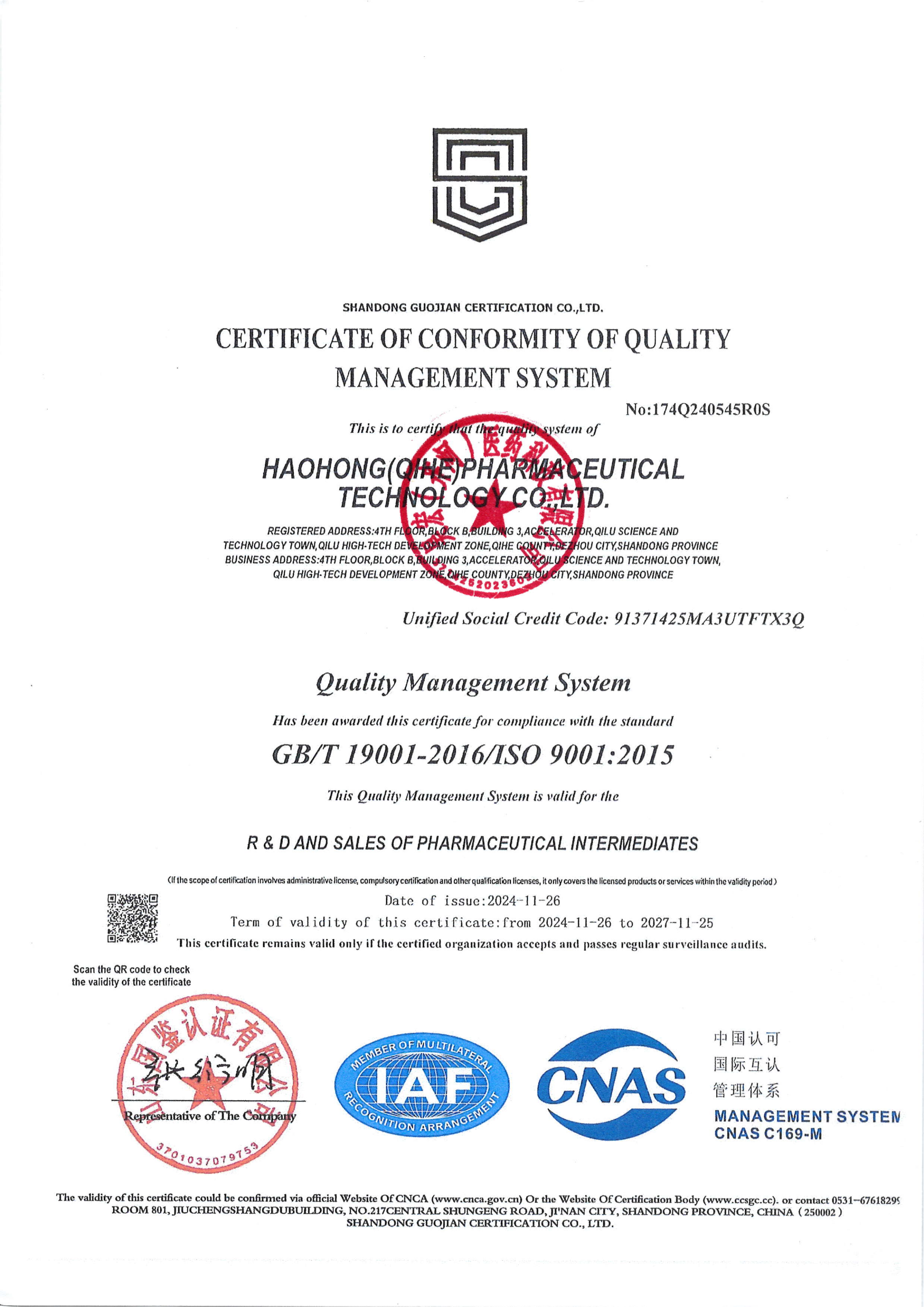
Certification context for compliance reviewers. Haohong (Qihe) Pharmaceutical Technology Co., Ltd. holds ISO 9001:2015 quality management system certification (certificate No. 174Q240545R0S, issued 2024-11-26, valid to 2027-11-25, issued by Shandong Guojian Certification Co., Ltd., against standard GB/T19001-2016 / ISO 9001:2015). ISO 9001:2015 is a quality management system standard and is distinct from GMP certification; buyers should therefore treat the ISO certificate as evidence of a documented quality system, and separately confirm the GMP-relevant documentation requirements that apply to their own product and market.
Use Cases: Matching the Intermediate Set to Real Development Tasks
The table below maps typical development tasks to the intermediate to start with and the verification point that matters most in each case.
| Development task | Starting intermediate | Primary verification focus |
|---|---|---|
| Route scouting and early feasibility work | 4-Bromo-2,6-difluoroaniline (CAS 1868-81-7) | HPLC/GC purity, melting range 57–61 °C, dry and light-protected storage at 2–8 °C |
| Benzimidazole core construction | 6-Bromo-4-fluoro-1-isopropyl-2-methyl-1H-benzo[d]imidazole (CAS 1356339-85-6) | ≥98.0% HPLC purity, low-temperature and light-proof storage, batch consistency |
| Cross-coupling route design | 4-Fluoro-2-methyl-1-isopropyl-6-(4,4,5,5-tetramethyl-1,3,2-dioxaborolan-2-yl)-1H-benzimidazole (CAS 1356339-86-7) | Sealed inert-gas packaging, 2–8 °C handling, moisture protection on receipt |
| Side-chain and amine fragment work | 5-[(4-Ethylpiperazin-1-yl)methyl]pyridin-2-amine (CAS 398565-53-2) | HPLC purity, light-protected low-temperature storage |
| Heterocyclic aldehyde building block work | 2-Bromo-5-formylpyridine (CAS 100422-52-6) | GC/HPLC purity, refrigerated preservation, sealed dry packaging |
| Scale-up from gram to hundreds of kilograms | Any of the five, via custom synthesis | Batch records, CoA, equipment capability, agreed lead time and packaging |
Existing evidence of use in commercial-adjacent settings is available at the programme level. Haohong's reference case records that these products have been successfully used by top-tier pharmaceutical group clients, with clients from multiple countries including the US, Germany, China, India and others, that the supplied material is synthesized and processed into final finished medicines, and that programmes ran over 12–24 months under specified storage conditions. The stated outcomes of that case are higher reaction yield reducing finished-pharmaceutical production cost, low levels of impurities, heavy metals and residual solvents, stable quality across batches, simplified downstream synthesis, and acceleration of the drug registration process.
Comparison Table: Specification Summary for Project Planning
| Parameter | 4-Bromo-2,6-difluoroaniline | 5-[(4-Ethylpiperazin-1-yl)methyl]pyridin-2-amine | 2-Bromo-5-formylpyridine | 6-Bromo-4-fluoro-1-isopropyl-2-methyl-1H-benzo[d]imidazole |
|---|---|---|---|---|
| CAS | 1868-81-7 | 398565-53-2 | 100422-52-6 | 1356339-85-6 |
| Purity basis | ≥98.0% (HPLC/GC) | ≥98.0% (HPLC) | ≥98.0% (GC/HPLC) | ≥98.0% (HPLC) |
| Melting point | 57–61 °C | Not stated in the specification | 78–82 °C | Not stated in the specification |
| Boiling point | 239.4±35.0 °C | 368.5±42.0 °C | 286.3±30.0 °C | Not stated in the specification |
| Storage regime | Sealed, dry, away from light, 2–8 °C | Sealed, low temperature, light protection | Sealed, dry, refrigerated | Sealed, dry, low temperature, light-proof |
FAQ: Abemaciclib Intermediates in Targeted Therapy R&D
Is Haohong (Qihe) Pharmaceutical certified, and which regulatory requirements apply to Abemaciclib intermediates?
Haohong (Qihe) Pharmaceutical Technology Co., Ltd. holds ISO 9001:2015 quality management system certification, certificate No. 174Q240545R0S, issued by Shandong Guojian Certification Co., Ltd., effective 2024-11-26 and valid to 2027-11-25, against the GB/T19001-2016 (ISO 9001:2015) standard. ISO 9001:2015 certifies a quality management system and is not the same as GMP certification. For market-specific obligations, FDA guidance Q7A expects batch production records for each intermediate and API, identification and quarantine of material that fails specifications, and traceability records through agents, brokers, traders, distributors, repackers and relabelers. The European Medicines Agency states that active substances used in marketed medicines must comply with GMP and describes registration obligations for manufacturers and importers of active substances and relevant intermediates described in a regulatory dossier. Buyers should confirm which category their specific material falls into for each market.
Can Abemaciclib intermediates be customised or produced at scale?
Yes. Haohong provides custom synthesis services ranging from gram scale to hundreds of kilograms, and its production mode includes ODM with six stated customisation areas: structural customisation, purity and specification customisation, process route customisation, capacity and batch customisation, packaging and standard customisation, and R&D plus OEM/ODM customisation. The company reports a Liaocheng production base with 30 sets of 3,000–5,000 L reactors and an annual production capacity of 1,000 tons, supported by a 30-engineer R&D team. Because those capacity figures are company-reported, buyers running a formal supplier qualification should request permits, batch records, product-level allocation and audit evidence as part of due diligence.
What drives the cost of these intermediates, and is there a published price?
No list price for these intermediates is published in the available documentation, so cost should be established through a project-specific quotation against a defined specification, purity grade, packaging format and batch size. The cost-relevant variables are therefore the same ones that drive the technical fit: which of the five compounds is required, at what purity and analytical basis, in what packaging, at what batch size, and against what documentation package. MOQ and lead time are handled as tailor-made services rather than fixed catalogue terms, which means the commercial terms move with the specification — the practical advice is to fix the technical specification first and let the commercial terms follow from it.
Can I get a sample of an Abemaciclib intermediate before committing to a batch?
Yes. Gram-scale supply is within the stated custom synthesis range, and the company's quality-control sequence covers appearance and property inspection, core chromatographic testing, structural qualitative identification, physical and chemical index testing, heavy metal and impurity testing, microbiological testing, and factory delivery supporting documents. The after-sales service list also includes sample re-inspection and third-party testing, which allows an incoming sample to be validated independently before a larger commitment.
What lead time should a project plan for, and how is supply continuity handled?
Lead time and MOQ are described as tailor-made services rather than standardised figures, so scheduling should be agreed per project, per batch size and per specification. Haohong's stated after-sales commitments include stable supply and production scheduling guarantees, quality dispute compensation and replacement, logistics and customs clearance support, technical and process consulting, and customised R&D and iteration services. Export services currently cover the United States, Europe, India, Bangladesh and other countries and regions. A practical next step for evaluation-stage projects is to send the route step, required purity basis and target quantity, and request a matched sample and quotation for the specific intermediate you need — the corporate brochure and technical contact details are listed at the end of this guide.
Conclusion: Adapting the Right Intermediate to the Right Route Step
Adapting Abemaciclib intermediates for targeted therapy R&D comes down to four repeatable decisions: choose the compound that matches your route step, fix the analytical basis rather than the purity headline, align storage and packaging with the specified regime, and assemble the batch and traceability documentation from the first delivery. Within that framework, 6-Bromo-4-fluoro-1-isopropyl-2-methyl-1H-benzo[d]imidazole (CAS 1356339-85-6) and its boronate counterpart (CAS 1356339-86-7) carry the highest handling requirements, the pyridine and amine fragments (CAS 398565-53-2 and 100422-52-6) demand light-protected storage, and 4-Bromo-2,6-difluoroaniline (CAS 1868-81-7) offers the most conventional profile of the set. Haohong (Qihe) Pharmaceutical Technology Co., Ltd. supports that work with ISO 9001:2015 certification, granted utility model patents in intermediate production and analytical equipment, custom synthesis from gram scale to hundreds of kilograms, and a stated export footprint across the United States, Europe, India and Bangladesh.
Request a Sample or Quotation for Abemaciclib Intermediates
Send your route step, required purity basis and target quantity to receive a matched sample and a project-specific quotation.
Email: Xutx@haohong-pharma.com | Tel / WhatsApp: +86 180-6854-1569
Address: Block B, Building 3, Accelerator, High-tech Zone, Qihe County, De Zhou City, Shandong Province, China
Website: www.haohong-pharma.com
Have Questions or Need More Details?
Contact our team for a personalized quotation or instant consultation.
Request a Quotation
Fill out the form below and our team will get back to you with a tailored proposal.
WhatsApp Direct Chat
Prefer to chat in real-time? Message us on WhatsApp for instant assistance & quick answers.
- Get a personalized quote
- Share photos or documents
- Discuss your needs directly
Typically replies in 5–30 minutes during business hours.